

The 23/09/2026
The Saint-Michel Tumulus in Carnac: On the Giant’s Shoulders!
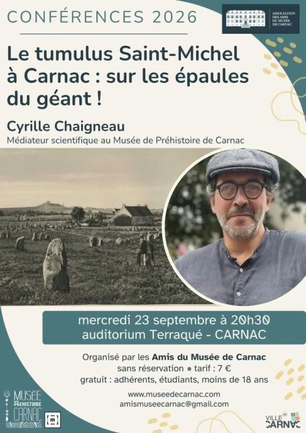
Lecture led by Cyrille Chaigneau
The Carnacean tumuli, emblems of the Morbihan Neolithic period, bear witness—as early as the 5th millennium BCE—to the emergence of a powerful religious or political aristocracy, as evidenced by their immense size and the richness of their grave goods. The term “Carnacean” refers to a massive sedimentary mound covering a closed burial chamber without a passageway. Sedimentary analyses reveal that this soil originated from marshy areas 3 to 5 kilometers away, underscoring a monumental and ostentatious collective effort.
Built in the middle of the 5th millennium and associated with the Early Castellic period, the Saint-Michel tumulus—at 44 meters, the highest point in Quiberon Bay—offers an unparalleled view of the coastline and the alignments of stelae. The site demonstrates an unbroken continuity of religious practice, from the Neolithic period to the present-day chapel (rebuilt in 1926), including a potential Gallo-Roman temple dedicated to Mercury and medieval settlements established at its base.
A prehistorian by training and an experimental archaeologist, Cyrille Chaigneau is a science educator at the Carnac Museum of Prehistory and a researcher specializing in monumental architecture of the recent prehistoric period.
As the founder and lead coordinator of the association Les Vaisseaux de Pierres, he explores and highlights the significance of this unique heritage in the history of the arts, the collective imagination, and the construction of identity.
No reservation required
The Carnacean tumuli, emblems of the Morbihan Neolithic period, bear witness—as early as the 5th millennium BCE—to the emergence of a powerful religious or political aristocracy, as evidenced by their immense size and the richness of their grave goods. The term “Carnacean” refers to a massive sedimentary mound covering a closed burial chamber without a passageway. Sedimentary analyses reveal that this soil originated from marshy areas 3 to 5 kilometers away, underscoring a monumental and ostentatious collective effort.
Built in the middle of the 5th millennium and associated with the Early Castellic period, the Saint-Michel tumulus—at 44 meters, the highest point in Quiberon Bay—offers an unparalleled view of the coastline and the alignments of stelae. The site demonstrates an unbroken continuity of religious practice, from the Neolithic period to the present-day chapel (rebuilt in 1926), including a potential Gallo-Roman temple dedicated to Mercury and medieval settlements established at its base.
A prehistorian by training and an experimental archaeologist, Cyrille Chaigneau is a science educator at the Carnac Museum of Prehistory and a researcher specializing in monumental architecture of the recent prehistoric period.
As the founder and lead coordinator of the association Les Vaisseaux de Pierres, he explores and highlights the significance of this unique heritage in the history of the arts, the collective imagination, and the construction of identity.
No reservation required
Opening times
On 23/09/2026
from 20:30
See more dates
auditorium Terraqué
56340 Carnac
56340 Carnac
Pricing
Base rate (18 ans et +)
7 €
Subscriber rate (Gratuité : adhérents, étudiants, - 18 ans)
0 €
Input
Paying
Spoken languages
French